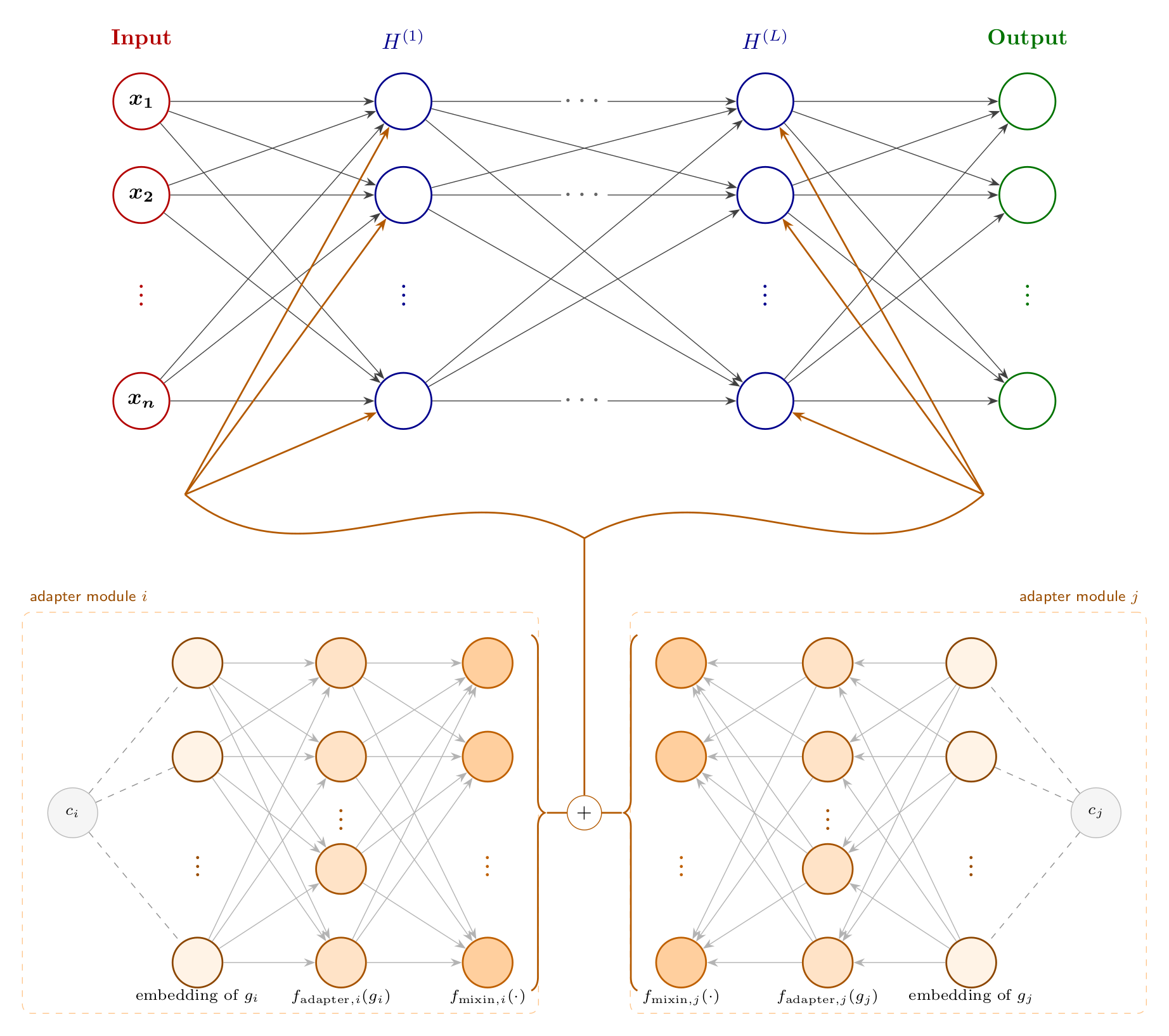
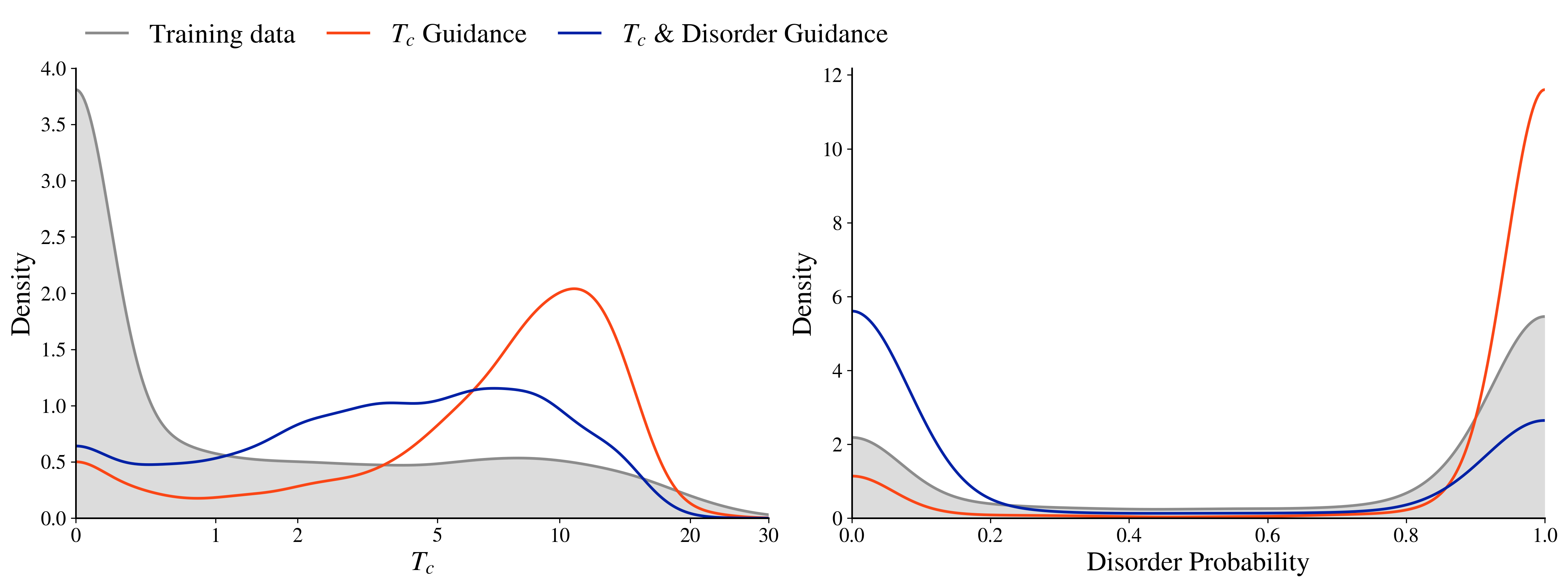
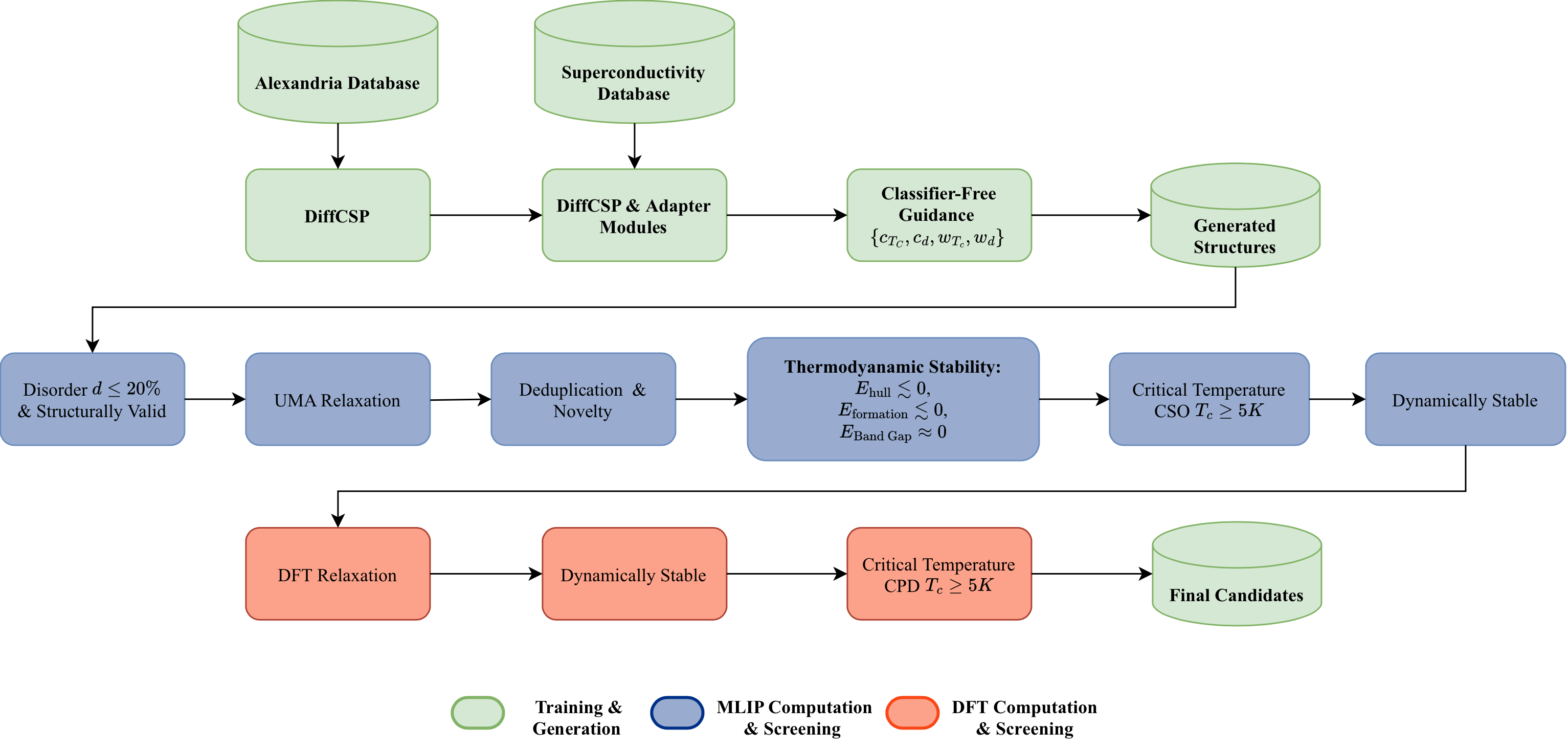
Network architecture for conditioning on two properties at once. Each conditioning variable (ci, cj), here superconducting critical temperature and disorder probability, gets its own adapter module: the variable is embedded (gi), passed through a small adapter network fadapter,i, and projected by a mix-in layer fmixin,i. The outputs of the two adapter modules are summed and injected into every hidden layer H(1), …, H(L) of the pretrained diffusion network, so a single fine-tuned model can be steered toward both properties simultaneously. Click the figure to view it at full size.Distributions of superconducting critical temperature (left) and disorder probability (right) for the training data and for structures generated with Tc guidance alone and with joint Tc & disorder guidance.Screening pipeline from generated structures to final candidates. A DiffCSP model trained on the Alexandria database is fine-tuned with adapter modules on a superconductivity database and sampled with classifier-free guidance on Tc and disorder (green). Generated structures are first screened with machine-learned interatomic potentials (blue). Structures are kept if they are structurally valid with a predicted disorder probability d ≤ 20%. They are then relaxed with UMA, deduplicated and checked for novelty, and kept only if they are thermodynamically stable (Ehull ≲ 0, Eformation ≲ 0), metallic (band gap ≈ 0), predicted to have Tc ≥ 5 K, and dynamically stable. The remaining structures are re-relaxed and re-checked with density functional theory (red) for dynamical stability and Tc ≥ 5 K, giving the final candidates passed to experimental collaborators for synthesis. Click the figure to view it at full size.